Now Reading: I Used The Redmi Note 13 Pro 5G For 30 Days And This Happened
-
01
I Used The Redmi Note 13 Pro 5G For 30 Days And This Happened

Intro
After 30 days with the Redmi Note 13 Pro 5G, I’m seriously asking myself: why did I ever pay over a thousand dollars for a phone? I ditched my flagship for this mid-range phone to see if it could handle my daily life, and the results… were not what I expected. This phone made me question the very line between “budget” and “premium.” In this video, I’ll show you what blew me away, what let me down, and whether this phone is actually good enough to replace your pricey daily driver.
The Premise
Let’s be real, we’ve all been there. You’re scrolling through reviews of the newest flagship, a device that costs more than a good laptop, and you think, “Do I really need all that?” I was right there with you. As a tech reviewer, I get to use some of the best phones out there, but I’ve always been curious about the mid-range. What are you actually giving up when you save six, seven, or even eight hundred bucks?
So, I decided to find out. I put my trusty, expensive flagship away in a drawer and moved my entire digital life—SIM card, apps, work, everything—over to the Redmi Note 13 Pro 5G. A phone that costs a tiny fraction of the price. I figured I’d feel the compromises instantly. I was expecting lag, a camera that would make me want to cry, and a battery that would have me hunting for a charger by mid-afternoon. I was ready to be disappointed. But for 30 days, this was it. My one and only. The goal was to see if it could just survive, or if maybe, just maybe, it could actually compete.
Initial Impressions – The Honeymoon Phase
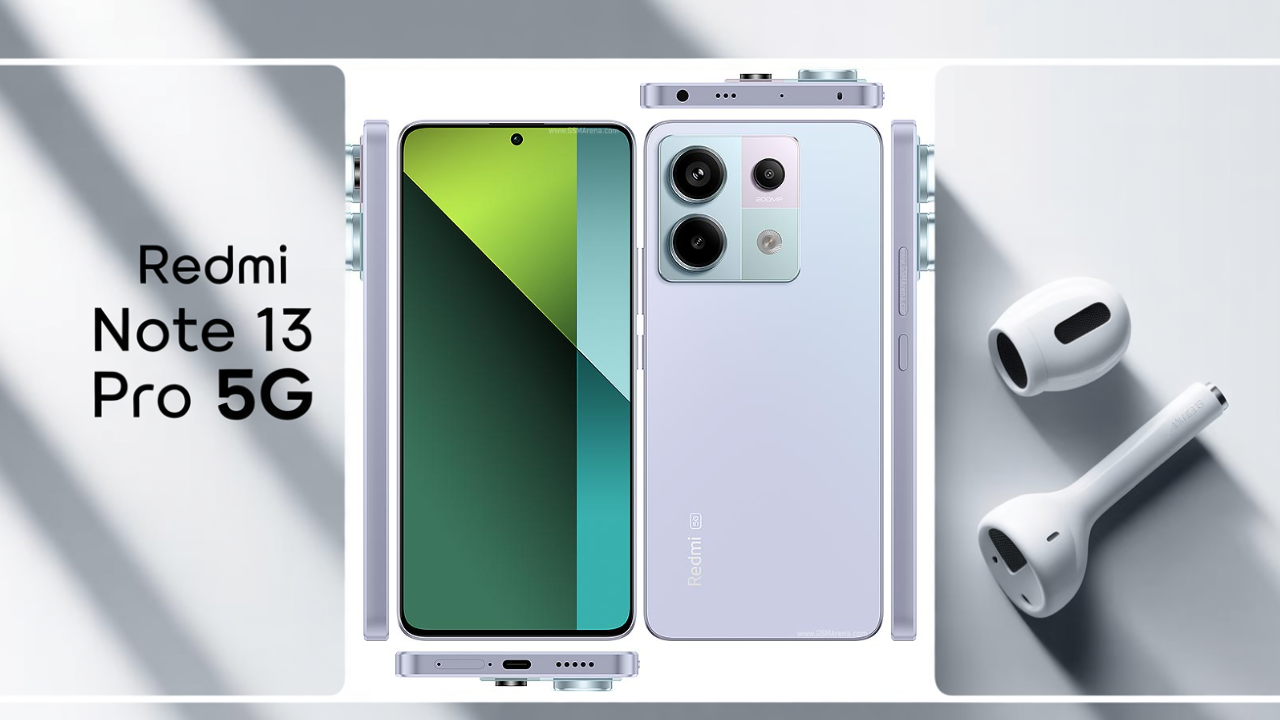
The whole thing starts with the unboxing, and right away, it felt different. You don’t get the fancy, theatrical unboxing of a flagship, but you get everything you need. That includes a 67-watt charger and a case, which is more than you can say for most thousand-dollar phones these days. “Redmi Note 13 Pro 5G”
Picking up the phone, it doesn’t feel cheap. It has a glass back and a sleek, flat-edged design that’s modern and comfortable to hold. It feels solid. But the first real shock came when I powered it on. The display. This is a 6.67-inch AMOLED screen with a 120Hz refresh rate, and it is stunning. The bezels are so thin they’re barely there, giving it a look that punches way above its price.
This isn’t just about specs on a page; it’s about how it feels. Scrolling through social media, websites, and just moving around the interface is incredibly fluid. It’s that buttery-smooth feeling you usually associate with top-tier phones. But it gets better. The display has a peak brightness of up to 1800 nits. In plain English, that means using it outside, even in harsh, direct sunlight, is no problem at all. The screen stays vibrant and perfectly readable. I spent an afternoon in a park answering emails, and I never had to squint or cover the screen. This is a level of quality that, just a few years ago, was only on flagship phones. The screen is also protected by Corning’s Gorilla Glass 5, which gives you a solid level of protection against scratches that you don’t always see at this price.
Setting up the phone was easy. It runs on Xiaomi’s interface over Android. It’s packed with features, and after a few tweaks to get it just right, the software felt quick and responsive. My first few days, the “honeymoon phase,” were full of these little surprises. I kept waiting for the catch, for the big compromise that would justify the price tag. In those first few days, I honestly couldn’t find it.
The Turning Point – The Challenge
First impressions are one thing, but a phone shows its true colors when you push it. The honeymoon was over. It was time for the challenge. I wasn’t just going to use the Redmi Note 13 Pro 5G casually; I was going to put it through the exact same intense, demanding routine my flagship phone puts up with every day.
That meant it became the center of my life. For work, I was juggling Slack, Trello, dozens of Chrome tabs, a flood of emails, and video calls. For my social life, it was constant scrolling, posting, and watching content on Instagram, TikTok, and YouTube.
But I took it a step further. I was working on a project that meant taking tons of photos and videos, so the camera was under constant pressure in all kinds of light. And finally, the ultimate test for any mid-range phone: gaming. Not just a quick puzzle game, but long, intense sessions of graphically demanding titles like Genshin Impact and PUBG Mobile.
This is where mid-range phones usually crack. They start to stutter, apps reload, the phone gets hot, and the battery just dies. I designed this whole process to find the phone’s breaking point. I wanted to know where its limits were. The challenge was on.
Performance – Thematic Deep Dive
Performance is the engine of a phone, and it’s often where companies cut corners to lower the price. The Redmi Note 13 Pro 5G is powered by the Qualcomm Snapdragon 7s Gen 2 chipset. On paper, that’s a mid-range processor. In reality, for about 95% of what I do every day, it felt shockingly close to a flagship.
Let’s talk daily use. I’m a heavy multitasker. I’ll often have twenty Chrome tabs open, a podcast playing on Spotify, and be jumping between Slack, email, and Twitter. This is where phones with less power start to fall apart. Apps lag, the keyboard stutters—you know that frustrating delay. With the Redmi and its generous amount of RAM, that just wasn’t an issue. App switching was swift, and I rarely saw an app have to reload from scratch. It just worked, smoothly and reliably. The 120Hz display and this processor make for an experience that feels consistently snappy.
But daily tasks are one thing. The real test is gaming. I installed PUBG Mobile and Mobile Legends, two games that can really push a system. The Adreno 710 GPU isn’t a world-beater, but it’s surprisingly capable. In PUBG, I could play on Smooth graphics with an Extreme frame rate, and the gameplay was consistently stable. I was hitting a steady 55-60 frames per second with very few drops, even in chaotic firefights. More impressively, the phone handled its heat really well. After a 45-minute session, it was just slightly warm, never uncomfortably hot—a problem I’ve had with much more expensive phones. While it won’t run every single game at the absolute highest settings, it gives you a genuinely fun and competitive gaming experience. It proves you don’t need to spend a fortune to play demanding games on the go.
If you care about benchmarks, the phone’s AnTuTu score is around 600,000. But that’s just a number. What it feels like is a phone that has more than enough power to handle what the average person, and even a power user like me, throws at it without breaking a sweat. The real-world performance gap between this and a top-tier flagship has gotten unbelievably small. “Redmi Note 13 Pro 5G”
Battery Life & Charging – Thematic Deep Dive
If performance was a nice surprise, the battery and charging were a total game-changer. This is where a phone proves its worth. It doesn’t matter how fast or beautiful your phone is if it’s dead by 5 PM. The Redmi Note 13 Pro 5G has a big 5100mAh battery, and its endurance is impressive.
On a typical day with moderate use—social media, emails, music, a few photos—I’d end the day with around 40% left. That’s solid. But what about a heavy day? One day, I really went for it. I started at 7 AM, used Google Maps for an hour, watched about two hours of YouTube, gamed for a couple of hours, and took over 100 photos. By 11 PM, I was at 15%. It made it through the entire day, which is fantastic. The battery life is reliable and will easily get most people through a full day without any anxiety.
But the real story here isn’t just how long it lasts; it’s the charging speed. The phone comes with a 67-watt fast charger in the box. This isn’t just fast; it’s a feature that completely changed my habits. I stopped charging my phone overnight. There was no point.
Here’s a real-world scenario that happened over and over: I’d wake up, see the phone was at 20%, plug it in, take a shower, and by the time I was ready 15-20 minutes later, it would be over 50% charged. That’s enough to last for hours. A full charge from nearly empty takes about 44 minutes. This feature completely eliminates battery anxiety. It means that even on a crazy heavy day, a quick 15-minute pit stop is all you need to get back in the game. It’s a genuinely premium feature that many flagship phones, including some of the most expensive ones, can’t match. And once you get used to this kind of speed, it’s hard to go back to anything slower.
If you’re finding this review helpful and maybe thinking about a mid-range phone yourself, a quick tap on that like button would be awesome. It really helps the channel out and tells me you want more long-term tests like this one.
The Camera – Thematic Deep Dive
The camera. This is the final boss for any mid-range phone. It’s almost always the biggest compromise, where flagships keep their lead. So, I went into this test with my expectations on the floor. The Redmi Note 13 Pro 5G, however, has a secret weapon: a massive 200-megapixel main camera with optical image stabilization.
Let’s start with the good, because it’s very good. In daylight, the photos from this main camera are fantastic. They are sharp, packed with detail, and the colors are vibrant without looking fake. Honestly, if you put a photo from this phone next to one from a flagship in good light, I’d have a hard time telling them apart. The big sensor pulls in a lot of light, making images look crisp and professional. The 2x zoom mode is also surprisingly clean, giving you usable shots with minimal quality loss. For your everyday photos of landscapes, people, and pets in bright conditions, this camera doesn’t just compete; it often matches the big players.
But this is where we have to talk about compromises. The main camera is joined by an 8-megapixel ultrawide and a 2-megapixel macro camera. The ultrawide is… fine. It’s useful for getting more in the frame, but the photos are noticeably softer and less detailed. The colors don’t quite match the main sensor, and the quality drops fast in anything but perfect light. The 2-megapixel macro camera is, to be blunt, mostly there for the spec sheet. The results are often noisy and just don’t look great.
The biggest challenge, as expected, is low-light photography. When the sun goes down, the gap between this and a thousand-dollar phone shows. While the main camera’s night mode helps, images can come out looking a bit soft and grainy. It has trouble with complex night scenes, sometimes blowing out highlights. The photos are still fine for social media, but they lack the clean, crisp pop of a top-tier flagship. That’s the trade-off.
Video quality is decent, but it’s a clear step down from the photo side. It can shoot in 1080p, and the footage is sharp in good light, but it maxes out there—no 4K recording. The image stabilization does a good job of smoothing out minor shakes. The 16-megapixel front camera is perfectly fine for selfies and video calls, delivering clear results, though it can struggle a bit in dim lighting.
So, the camera system is a tale of two halves. That 200MP main sensor is a star performer in good light. But the other cameras are much weaker, and low-light is where you really feel the mid-range price. “Redmi Note 13 Pro 5G”
Build Quality & Daily Life – Thematic Deep Dive
After 30 days of being tossed onto desks, pulled from pockets, and just living life with me, how did the phone hold up? Remarkably well. The Gorilla Glass on the front is no joke; the screen is still pristine, without a single scratch. The glass back has also held up well against fingerprints and scuffs. It feels like a durable, well-built device.
But living with a phone is about more than just surviving drops. It’s the little things. And this phone has something that has become a true unicorn in the smartphone world: a 3.5mm headphone jack. For anyone who still loves their wired headphones, this is a huge win. No dongles, no fuss. It’s a practical, pro-consumer feature I was thrilled to have back.
The phone also has an IP54 rating for dust and splash resistance. This means you don’t need to panic if you get caught in the rain. You can’t take it swimming, but it’s peace of mind for everyday accidents. The stereo speakers are another great touch—they get surprisingly loud and are clear enough for watching videos without needing headphones. The under-display fingerprint sensor is fast and reliable. These aren’t flashy features, but they’re the quality-of-life additions that make a phone a pleasure to use every day. It’s a thoughtful device that doesn’t forget the essentials. “Redmi Note 13 Pro 5G”
The Revelation – The Climax
So, what was the big takeaway after 30 days? The surprise wasn’t that the Redmi Note 13 Pro 5G survived. The surprise was how rarely I actually missed my flagship phone. There were moments, sure—mostly trying to snap a photo in a dark restaurant. But those moments were few and far between.
For the vast majority of my time—the endless scrolling, messaging, multitasking for work, watching videos, and even gaming—this phone didn’t just keep up; it excelled. I had a flagship-quality display, more than enough performance, and a charging setup that’s genuinely better than most of the top-tier competition.
I realized I’d been paying a massive premium—hundreds of dollars—for the last 5-10% of performance and camera tricks. I was paying for a slightly better ultrawide camera I barely used and for low-light photo processing that only mattered in specific situations. The core experience, the 90% of what I do on my phone every single day, was pretty much identical. This experiment forced me to see the law of diminishing returns in action. The gap between mid-range and flagship isn’t just closing; for most people, it’s practically gone. “Redmi Note 13 Pro 5G”
The Verdict – The Resolution
After a month, it’s time for the verdict. Is the Redmi Note 13 Pro 5G a phone you should buy? The answer is a resounding yes, but with a couple of “ifs.”
Who is this phone for? It’s for the student who wants a powerful device for school and fun without going broke. It’s for the parent who needs a reliable phone with a great battery and a camera that takes beautiful family photos in good light. It’s for the savvy person who looks at a thousand-dollar phone and just asks, “Why?” For this huge group of people, this phone offers an experience that is 95% as good as a flagship, for less than half the price.
Who should skip it? If you’re a hardcore mobile gamer who needs to run every title at max settings, you might want a phone with a top-of-the-line processor. If your main passion is shooting photos in very dark places or you rely heavily on telephoto and ultrawide lenses, then the investment in a flagship camera might be worth it for you. And if you need the full assurance of IP68 waterproofing, you’ll need to look at more expensive options, though the pricier Pro+ model does offer that.
But for everyone else, the Redmi Note 13 Pro 5G marks a turning point. It’s proof that a “mid-range” phone in 2025 isn’t a device full of compromises anymore. It’s a smart choice that delivers a truly premium experience where it counts the most. “Redmi Note 13 Pro 5G”
Conclusion
This phone didn’t just survive my 30-day test; it genuinely impressed me. It fundamentally changed my view on what a budget-friendly device can be. It’s not about finding a cheap phone that’s “good enough.” It’s about realizing that phones this good have made expensive flagships a luxury, not a necessity.
Now, I want to hear from you. What’s your experience with mid-range phones? Have you made the switch from a flagship and never looked back? Let me know your story in the comments below.
If you enjoyed this long-term review and want to see more real-world tech tests, make sure to subscribe. Thanks for watching, and I’ll see you in the next one. “Redmi Note 13 Pro 5G”